Tuesday, June 9, 2009

Final Evaluation

    International Studies 501, Living Jerusalem was a very interesting and educational class. I feel that its open structure and discussion set it apart from all other class that the university has to offer. With that said, I would like to discuss both the positives and things that can be improved upon to provide a more tailored and focused educational experience for future students enrolled in the class.
1. The Class Discussions
    I can say  that I thoroughly enjoyed the open and respectful dialogue that the class is based on, focuses on, and helps students to develop. The open discussion was well needed because often times at a university as big as Ohio State it is hard to find classes the provide students with student to student and student to professor interaction. The discussion also helped me to develop a better understanding of the subject matter. The enjoyed the informality of the discussions because they allowed us to express our minds freely and not being prompted or coerced into thoughts. However, I feel that the lack of structure in the class discussions carried over into other aspects of the class, such as the blogs, and the video conferences. I feel that if a more focused discussion type were implemented it would benefit both the students and the project. I feel that a specific topic can be addressed and then discussed. I think giving each class a broad but generalized theme would help to create a more educational discourse.

2. The Readings
    Overall, the readings required for the course were very educational and left little room for confusion. I believe that the readings provided myself, as well as others, with  beneficial information to gain a better understanding of the history behind the conflict and to engage in educational and more thought provoking discussion. Moreover, I feel that some aspects of the material could be changed to help further grasp the information presented. I understand that the course is a higher level course but I feel that the readings could be more separated to make a more beneficial experience. I only mention this because I found it odd that the beginning of the course was filled with reading but as the quarter progressed the reading amount dwindled to nothing. I also mention this because it was often the case that our discussions concerning, Jerusalem: One City, Three Faiths was often cut short. I feel that if less material was covered at one time the class would be able hold more in-depth discussions and to absorb more information to help them develop more scholarly opinions and/or learn accordingly.
3. The Blogs
    I feel the class blogs are very interesting. At first, I was hesitant when I knew that a technological aspect would be incorporated into the class but as the quarter progressed I became comfortable with the class blog and my personal blog. I liked the blogging aspect of the course because it always made me open to discussion and it allowed me to express my thoughts outside of the classroom. One way that the blogs could be improved is to establish a certain type of format of posting to create cohesion throughout the student blogs. I feel that the different types of people and their personal style of responding in the blogs made it difficult to comment on posts.
4. The Class In General
    Overall, I think the class was a great experience. I really enjoyed the experience and I will recommend the class to friends in the future. The class was very interesting in the fact that it did not have a set structure but it still allowed us to learn. I feel that the class could be a little more structured to produce a little more clarity. There were often times especially near the end of the quarter where I felt confused. The experiences with the scholars, authors, professors, and students were exceptional and by far the highlight of the class. I enjoyed this aspect because the guests often raised thought provoking questions. The religious scholars and Dr. Hermann were very interesting and I would definitely recommend having them return to future classes. The only improvement that I have to offer in regard to the video conferences would be to have a set room or to have a classroom that has video conference capabilities. I enjoyed the class because it helped me to become more educated on the conflict, Jerusalem, and injustices as a whole. I enjoyed how the content incorporated different aspects of life. The only thing that I would recommend be added to the course would be a section on what it is or what means to live in modern day Jerusalem.
    In conclusion, I thoroughly enjoyed being a student in the Living Jerusalem 2009 course. I know that there is room for improvement in the class but nonetheless I can say that I learn a great deal of information from material.

Wednesday, May 20, 2009

Response to the Readings(Week 8 Pt. 2)

Old and New Walls in Jerusalem

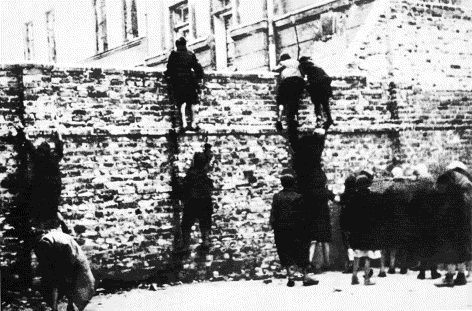
Throughout the reading I could only think of one thing, how wrong that the wall is. As discussed in the reading the wall in inhumane and is used to separate things of unequal qualities. I can only think that this is very similar to the ways Jews were quartered off during WWII and put into ghettos. This is the same concept they are sectioning off the city and forcing Arabs to move into the sections for “safety” reasons. I don't see how the Jewish Israeli government can do this while thinking they are don't good. One would think they would recognize such inhumane actions because of the events that their ancestors faced which led to the founding of the Israeli state.

Above:A photo of Palestinians near the wall in Israel

Below: A photo of Jews near the wall that created the Warsaw Ghetto

Monday, May 18, 2009

Response to the Readings (Week 8)

I found the articles for this week very off the wall. I know they relate to the broad topic of Jerusalem but I don't see how they tie into what we are reviewing at this moment. I especially enjoyed the reading about architecture because the article relates to what I am learning in my Intro. to Architecture class. I enjoyed the statement, "Architecture can reflect and represent the cultural aspiration of a community." This quote is very powerful and it relates to architecture as a whole and not only in Jerusalem.

Tuesday, May 12, 2009

Response to the Readings(Week 7)

Jerusalem: Not the Mother of All Cities

I found that the essay was presented in a very unique way. I liked how Hasan-Rokem used the metaphor of marriage when referencing Jerusalem. I found it very intriguing to look at the conflict through the eyes of a woman. I enjoyed the section where Hasan-Rokem stated that Jerusalem was a city with needs. I think that with all of the conflict people have forgotten that people actually inhabit the city and conduct daily activities there.

Sharon and My Mother-in-Law

The stories presented by Suad Amiry were very interesting. They were both informational and entertaining. I liked that the reading was rather easy and allowed the reader to gather a lot of information relating to daily life. It was interesting to see the views of Palestinians and the ways in which they were discriminated against. I found it ironic that Emily was the friend but also the oppressor. The stories not only provided a detailed account but they revealed the injustices that the Palestinians faced in daily life. I found it quit funny that animals were given more rights than people in chapter 7 of the readings. I feel these sections of the novel present the oppression of the Palestinians in a playful way to avoid hostility and to bring light to the situation in a non-confrontational manner. Because of that aspect I enjoyed the readings.

Monday, May 11, 2009

Outline for Final Project

Introduction- Overview of “Art” (a collage of some sort)
Music- Discuss how modern contemporary music has been influenced by the conflict. I plan on having samples of music and video clips. I hope to show and discuss music form Oren Lavie, Yael Naim, Achinoam Nini, and Mira Awad.
Dance- I am interviewing an OSU graduate student who lived in Israel and danced for an Israeli dance company I am also planning on focusing on the Batsheva Dance Company.
Some Questions:
-What was your experience like in Israel as a dancer?
-Could you see a direct correlation between the battle over land and the development of the arts in general?
-What specific aspects have helped to shaped the modern dance world?
-Do you feel that dance has become a way to make political statements, create awareness?
Theatre- I would like to discuss the plays "Seven Other Children" and “Seven Jewish Children: A Play for Gaza". I am also planning on talking about the filming of the movie Jesus Christ Superstar.
Painting-I would like to talk about Mohammed Ali, and "guerrilla" artist Banksy. They are both graffiti muralists.

Wednesday, May 6, 2009

Tamari Readings

I found the readings to be very interesting because rather than focusing on the conflicts that were taking place at the time they focused on how events were shaped as a result of the conflicts. I found the article about music especially interesting because of my passion for the arts. They are many aspects that I enjoyed abut eth readings because they were so different. However, I have many questions. I would like to know why Tamari used different styles of writing and why he made some of his choices on diction. It really bothered me that he referred to religions as cults. I feel that the word cult has such a negative connotation and I wonder why he used that term.

Tuesday, May 5, 2009

Final Project

For my final project I am going to focus on how the arts have been shaped by conflict and also how they have developed through the conflict. I am going to do research on music, dance, painting, and other various types of art. I have set up an interview with an American dancer who is also focusing on a similar topic. If anyone knows of anything that could possibly be of use let me know.

Monday, May 4, 2009

Channels of Rage: A Response to the Documentary

Channels of Rage is a film that tells the story of three Israeli rappers as the try to make it in the music industry and raise awareness to the problems between Israel and Palestine. The award winning documentary was very interesting and well shot. The cinematography of the film was amazing. I feel the movie provided its audience with an accurate portrayal of the lives of Israeli rappers and the struggles they face. The film was intriguing in the way in which it displayed the power of music. The documentary showed how music is used to make political statements.

However, I feel the movie also provided a different view. Rather than solely focusing on the music and its effect I feel the documentary reinforced stereotypical aspects of life associated with rappers. The film showed the artists partying, wearing baggy clothes, using vulgar language, and wearing flashy jewelry.

Although the film had a powerful message, I feel that the story portrayed is not a positive one. The original goals of the artists were to bring light to the situation, but the film ended in a manner that the made me feel as if the artists just increased the problems and hatred that are in Israel. In the process of becoming well know Shadow's and Subliminal's fans shouted discriminatory phrases and Tamer was arrested.

Sunday, May 3, 2009

Can You Feel the Beat?

Music Organization

2b Vibes Music is a music production company that is committed to easing the minds of as many Israelis through music. 2b Vibes Music produces 20 annual film, dance, and music events in Israel. Last August it launched the inaugural Arab-Jewish Coexistence Festival that featured Joe Crocker. Earlier in 2007, the company launched the Jerusalem Rocks Festival, which included performances from the Black Eyed Peas, Arrested Development and The Commitments. 2b produces concerts in Mitzpe Ramon, Netanya, Jerusalem, Hadera, Arad, Tiberias, Sderot, Tel Aviv, and Beit Shean.

Hillel Wachs of 2b Vibes Music stated the goal of the company is to, “up the threshold level for producing an outstanding show.” 2b Vibes produces  shows at seven major university festivals in Israel annually and many other smaller campus events. The biggest impact 2b has had was booking Macy Gray for the Student Day Festival at Hebrew University in Jerusalem. When Gray performs she will become the first international artist to headline an Israeli university music festival. Previously, only top local acts have been featured at the event. Gray will not be the only artist to perform, Geva Alon and Michael Greilsammer, as well as other leading Israeli artists will be featured at the festival. 2b Vibes has been the production company for the event for the past three years. The show attracts an estimated 15,000 participants annually.

Links to Reviews of Channels of Rage http://www.variety.com/review/VE1117925365.html?categoryid=31&cs=1

http://www.culturewars.org.uk/2004-01/channels.htm

What would Rosa Do?

On Wednesday, April 20 a peaceful protest took place in the city of Jerusalem. The protesters were making a statement about segregation on Egged buses. The Company (Egged) introduced a Jewish bus route in the early 1990's. Since then the trend has spread and has resulted in a number of mehadrin bus lines in the city. The mehadrin bus lines have caused controversy because they call for the separation between women and men. Usually the women sit in the back and men in the front. These segregated lines travel between Orthodox neighborhoods inside and outside Jerusalem and connect neighborhoods with the Old City for those who want to reach the Western Wall without going through secular neighborhoods.

The outrage is coming from the public who oppose this separation because Egged is now attempting to mehadrinize many buses that run in secular neighborhoods. Because of this many residents feel that the separation is infringing on the citizens rights. Since the concept of mehadrin buses appeared there have been many conflicts as a result of the segregation.
one of the most well known cases is the story of
Naomi Ragen, an Orthodox and feminist writer who refused to move to the back of a bus when asked. In a interview Ragen spoke about the situation by saying, "I call these buses the Taliban lines. You know, they can call it whatever they want, but that to me is what they are."

On the other side of the matter, those who support the decision to separate the buses argue that Jews should be able to "reach the Wall in purity", separated buses are cheaper, and run more often. They say that men are weak and give into temptation therefore human nature calls for the separation. The main supporters state, "it becomes impossible for us, the secular passengers dress in a way that is absolutely unbearable for us."

I feel that with all of the problems in modern society, an issue with segregated buses is the least of Jerusalem's problems. The reasons used to support the segregation of individuals based on sex are totally invalid arguments. The main basis is totally childish, somewhat humorous, and should not even be a concern in a matter such as this. If men having illicit thoughts on a bus is the main reason to segregate a bus then why don't they just segregate society? I feel that the matters here are just another political attempt to make Jerusalem an even more "Jewish" city.


Saturday, May 2, 2009

Selling Your Own Properity = Treason

On Tuesday, a Palestinian court sentenced a man to death for selling land in the West Bank to Israelis. The court in Hebron sentenced the man 59 year old man, Anwat Breghit, to death by hanging after finding him guilty of treason and of selling Palestinian land to Israelis. The indictment says he sold property in the village of Beit Omar to Israelis from the Jewish settlement of Karmei Tzur. The sentence requires the approval of President in order to be carried out.

I feel that decisions such as these are the primary source to the continuation of the conflict. If the man rightfully owned the land he should be able to do with it as he pleased. If the government continues to make decisions that promote these beliefs the problems will persist and a soultion will never be achievable.

Tuesday, April 28, 2009

A Sufi Ceremony

This is a brief video of a Sufi religious ceremony that I captured in my recent travels to Turkey. Armstrong briefly discussed Sufism in the last chapters of the novel. Sufism is a branch of Islam. The most well know order of Sufism is that of the Whirling Dervishes. The Whirling Dervishes are famous for their trance like state achieved during prayer.

Monday, April 27, 2009

Jerusalem: One City, Three Faiths- Chapters 16-18

The last section of the book was the section of the novel that I have been looking forward to since we began reading. The last section of the book addressed the beginnings of modern day Jerusalem. When addressing the modernization of Jerusalem I found it very interesting that it was compared to New York City by Edward Robinson. I found this ironic because New York City in the 1850's was marked by the beginnings of the industrial revolution, a sense of separatism in the United states, rebuilding, and over population- all things that I don't typically relate to Jerusalem.

The last chapters of the book were not typical to what I expected. I am kind of upset that Armstrong didn't provide a possible solution to what is going on, but then again the novel was a historical account and I don't feel it was on Armstrong's list of goals to write the future. I wish she could of at least gave an in depth explanation as to what each of the possibilities were and how feasible the are. I think the only reason I am slightly upset is because I was expecting this grandiose break through but she only gave nothing. I feel like I read this great account that was providing me with knowledge and then it just ended without a proper finish. I understand why Armstrong did this though, it is not her responsibility to create the future, just to help us better understand the past and how it correlates to modern times.

Wednesday, April 22, 2009

Jerusalem: One City, Three Faiths- Chapters 14-15

To begin with, of the all the sections of the book that we have read, I found this section to be the most appealing. I think it may be a biased view due the nature of my recent travels to Turkey and learning of Islamic culture. I was intrigued by the continual mention of Sufism and the Ottomans.

With that said, I would like to address Armstrong's statement made on page 298. Armstrong states, "The Holy Land did not belong to either the Christians or the Muslims, Who were fighting over it at the present time." This passage struck me because I feel that the land actually belongs to nobody and everyone at the same time. As previously stated in class, the only reason why people lay claim to the land today is due to emotional attachment and not actual ownership in most cases. I feel that with all of the changing of power that has taken place in Jerusalem throughout history, even leading to the 1100's, it is total ludicrous to claim that the land belongs to one set of individuals.
IMG_1908 In chapter 15 the Ottoman Janissary were discussed. The two photos above and below are of a recreation of a typical Janissary march that I viewed while in Istanbul.

IMG_1909

Tuesday, April 21, 2009

Discrimination or Declaration?

The link below is to an article that I found rather interesting. The article addresses the topics of oppression and racism behind the demolition of Palestinian houses to build an archeological park in an eastern Jerusalem neighborhood.

http://www.jpost.com/servlet/Satellite?cid=1239710752849&pagename=JPost%2FJPArticle%2FShowFull

Home is Where the Heart is…Wherever You Live

Maybe it’s just my ignorance, but I had a different vision of what a house in Jerusalem would look like. I was surprised to find that the house portrayed is very similar to houses built in the United States. Andi and David Arnovitz, a couple from Atlanta, uprooted to Jerusalem and built a house in the Baka section of Jerusalem. Here are some photographs.


Controversy at the UN

The video below is of a controversial speech made Iranian President Mahmoud Ahmadinejad on Monday, April 20th at a United Nations conference on racism. I know that Mahmoud Ahmadinejad is not a well looked upon individual in the nation stage of foreign relations but, I feel that he is making a valid point. Previously, in class we discussed the actual “democraticness” of Israel and which allowed us to make our own conclusions.

In his speech Ahmadinejad is only expressing the truth according to the actual definition of democracy. The government of Israel has in fact created a racist platform through discrimination of Palestinians.  I think it is shameful that people can’t respect Ahmadinejad’s point for what it is worth. I acknowledge the fact that he is a leader and he should have approached the situation in a different manner, but none the less he is addressing a point that needs to be heard for the betterment of Israeli-Palestinian relations.

Monday, April 20, 2009

Jerusalem: One City, Three Faiths- Chapters 10-13

Chapters ten through thirteen were not very interesting contextually. I feel they are dragging on the story that has become so typical throughout the novel- war and more war for religious peace. However, this section of the novel made me more inquisitive about the mind of man. I find it fascinating that all of these unmerciful acts were being attributed to religion and were done in the name of God and religion. Not only were people persecuted but they were made to live in a true religious hell. When referring to the development of new monasteries Armstrong states, "Each settlement was thus a new Eden, a new beginning. The monks could live a paradisal life of intimacy with God, like the first Adam." What Armstrong indirectly alludes to is that the original inhabitants of the locations were displaced and disregarded.


Initially Jerusalem was to be a holy city of peace in the name of religion, regardless of the religious group that held power, but it was transformed into a holy city fueled by political agendas and greed. As one group took power they attempted to out show and show up the previous groups feats. I feel it is this mindset of doing better than the last or being more notable than others is the main fuel to the fire in the Israeli Palestinian conflict. From the readings I am drawing that Armstrong is making a statement against religion and its definition of peace. I think Armstrong is trying to reveal the faults of the three religions to prove that one is in fact not better than the rest. Therefore one religion cannot claim to have the sole right to call Jerusalem its holy city, but rather they all need to learn how to share it as equals.

Sunday, April 19, 2009

The Holy Fire in Jerusalem


This past Saturday Christian Orthodox pilgrims flocked to The Church of the Holy Sepulcher, the believed sight of the crucifixion of Jesus Christ, for an Easter celebration know as the ceremony of The Holy Fire in Jerusalem's Old City.

The ritual is believed to be over 1200 years old and stems from the Christian Orthodox belief that a holy fire appears spontaneously from Jesus' tomb as a message that he has not forgotten the devout. Over 10,000 followers were present at the ritual. Tensions were high due to the composition of the crowd. Greek Orthodox, Armenians and other Eastern Christians comprised the group of worshipers on Saturday. Police were present in the thousands and barricades were placed in the church to regulate the event and ensure the safety of all involved.

Note-Greek Orthodox, Armenians and other Eastern rite Christians mark Easter on Sunday, a week after observances by other Christian denominations, because they follow a different calendar

Wednesday, April 15, 2009

Jerusalem: One City, Three Faiths- Chapters 8-9

I am still indecisive about my feelings towards Armstrong's novel. One side of me is interested with the historical aspect of the novel however, I wish we would learn more about the present times of Jerusalem. I understand that the novel is developing but in my mind it is developing to slow. I feel as if the novel is dragging on and on.

One thing that struck me in these chapters was Armstrong's statements and development of the oppressive approach taken by the Christians towards the  Jews. Through out these chapters Armstrong gives subtle hints then at the end she directly states that the Jews were discriminated against.

The most memorable statement in these chapters was the Jewish belief that, “God created a single man at the beginning of time to teach us that whoever destroyed a single human life would be punished as though he had destroyed the whole world; similarly, to save a life was to redeem the whole world.” I find this statement powerful in times such as these because people as a whole have forgotten and/or neglected the respect of others. We as a society need to accept the fact that everyone may not have the same values or beliefs that we do and that difference doesn't make them any lesser a person than ourselves.

Tuesday, April 14, 2009

A Closer Look

As we delve farther into this novel I find more and more parallels to between the history of  conflict and religion in  Jerusalem that coincide with the modern Israeli Palestinian conflict. By providing a detailed history of the conflicts and explaining in detail the meaning of a holy cite Armstrong is creating an emphasis on the true meaning of Jerusalem to each religion. In Armstrong's account she states that a holy place functions as a gateway to the heavens. By stating this she proves that each religion, Christianity, Judaism, and Islam, have a tie to Jerusalem because it is or once was their gateway to the Heavens.

I feel that scholars would agree that the information presented thus far in Karen Armstrong's novel provides a well balanced account of the events that have shaped and scared Jerusalem for thousands of years. In my opinion I feel that Armstrong achieves a balance between the religions by providing a detailed account of the history both good and bad. By expressing the numerous accounts of concurring and re-concurring of the city, Armstrong develops a narrative that expresses how conflict has scared the city as well as built it to become the Jerusalem we know today.

Jerusalem: One City, Three Faiths- Chapters 5-7

In chapters five through seven I was more interested by the material than in the previous chapters because it was more informational and provided a different take information that I was already familiar with.

I enjoyed the detailed explanation of the true meaning of a “holy cite." I liked how Armstrong made the distinction that something that is holy to modern society is not considered to be holy on the same standards that were used to establish Jerusalem as a holy city.

After reading these chapters, I think I have an understanding as to why Armstrong is providing a detailed and confusing background. By expressing the complexity of the history of the city in the past she is indirectly making the statement that the conflict is detailed as well and cannot be understood in a matter of minutes due to its complexity. I also have a feeling that Armstrong is using the history to make the statement that the conflict as we know it is not something that began as a result of the formation of a Israel Jewish state but the conflict is something that dates back to the founding of Jerusalem.

Wednesday, April 8, 2009

Jerusalem: One City, Three Faiths – Chapters 1-4

To begin with, I found it very interesting that the title of my blog appeared in the text. I named my blog The Holy City of Peace as a display of irony. The name Jerusalem means peace and the city is a holy city therefore it is a holy city of peace. It is ironic in the fact that it is named for peace but living there is anything but peaceful and in the fact that religion and peace are intertwined but the most religious place lacks peace. Armstrong may have referenced Jerusalem in this way to make a bold statement or I may have misinterpreted this due to the bias of my own personal views.

The beginning chapters of the book were filled with information that seemed to overwhelm the reader and provide a link to the complexity of the conflict. However, the readings were very educational and provided a very detailed history of Jerusalem.

I feel like Armstrong made a powerful interjection that correctly sums up the history of many of the conflicts that have plagued Jerusalem since its founding with the statement, “war was waged for the sake of peace.”

Monday, April 6, 2009

A Better Understanding

While doing research I found a video that gave me a somewhat of a better understanding of the conflict. The link is posted below.
http://video.nytimes.com/video/2008/05/07/world/1194817477388/israels-arabs.html

Who am I? What represents me?

Below are a few things that represent who I am as an individual. I have many different interests in life and I can be defined in many different ways, but things I have chosen represent me the best

IMG_1359This photo was captured during Thanksgiving dinner 2008. Holidays are important to me because they represent family. Family is an integral part of my life. In my family alone there is probably as much conflict as in Jerusalem, although it is not as intense, it still has the family divided. The depicted Thanksgiving was the first time as an entire family we had a holiday celebration since 2001. Another aspect of myself portrayed in this picture is food. I love to eat the food prepared on Thanksgiving. If it were possible I would eat turkey, stuffing, yams, mashed potatoes, green beans and corn, deviled eggs, and cranberry sauce for every meal.

IMG_2344

This is a quilt that was give to my mother as a baby shower gift. I still use the quilt as sense of comfort and a means of remembrance. My mother died when I was ten and I feel like this quilt is my blanket both figuratively and literally. It is not only a patch work of cloth but I feel like it represents the many events that have shaped my life. It is frayed on the corners and strong on the inside.

The above picture is of the 2006-2007 Xenia High School Vocal Ensemble. I was a Member of this superior Choir. This group shaped my life and provided me with many life lesson, friends, mentors, and a lasting appreciation for the arts.

My favorite quote is from the Tony Award winning musical RENT “forget regret of life is yours to miss.” Rent is a powerful story that tells of the struggles of young adults. It conveys a powerful yet timeless message of love, acceptance, and equality. Below is a video clip of my favorite song form the musical.

Jerusalem: Gates to the City –A Review

The short documentary titled Jerusalem: Gates to the City was a film that gave a better understanding of the way in which life is divided in Jerusalem. By portraying both the Arabs and the Jews separately the film gave insight into the definite division of the city. Both groups were shown in daily life to depict them as individuals not as enemies. I enjoyed the fact that the movie generally strayed from the topic of conflict and depicted both sides while doing so. I feel the film correctly displayed the two distinct sub-cultures of Jerusalem while maintaining a neutral point of view.

I find the title interesting because it is addressing the fact that there is a clear division between the two distinct religious groups. In the past it was common for major city to have a gate as the main entrance to that city. However, the title of the film refers to more than one gate by using the plural form gates. This form is used because Jerusalem is one city that is divided into two distinct sub-cities. The film followed this thought by displaying the two sub-cities as cities of their own.

In Response to the Readings- Week Two

The readings for week two provided me with an insight to the history of Jerusalem. I found it very stunning to learn that the conflict is an ongoing struggle that has lasted for centuries. From the text, I gathered that the struggle has existed from the time of the founding of the city and has progressively worsened from then on out. I never knew that this problem has faced civilization for so long.

From the mind of an outsider I see the conflict as something that is primarily driven by political interests and has thus infiltrated the different religious groups. In “The history of Jerusalem” Khalidi states, “When discussing Jerusalem's history, it should be clear that what is really at issue is one narrative of that history, and not the thick accretion of religious beliefs and embellishments of the historical record over which the modem political agendas of Palestine and Israel compete.” I feel Khalidi is trying to convey is that the political agendas of the two opposing sides are combating each other and have therefore altered the way history is perceived. In Dumpers “Jerusalem Then and Now” it is discussed how the role of the government has played a major role in the unrest. The government mandates and population boosting attempts are two disturbing facts that have caused for a divide between the Arabs and the Jews. The conquering of Israel has become more religion oriented because of its political roots.

Thursday, April 2, 2009

Through All of the Turmoil the Arts Strive

With all of the turmoil created in the Israeli Palestinian Conflict, the arts have seemed to flourish as a means of expression as in many other turbulent periods throughout history. It is somewhat disturbing to think that such greatness in self expression can come from such horror.

     Music - Oren Lavie a new artist hit the scene this year with his first single “Her Morning Elegance.” The Tel Aviv-born singer and songwriter never  expected to become a viral sensation. On the infamous sight YouTube the video has received over four and a half million hits on YouTube.


     Theatre - The theatre realm is even expanding. This year 13 fringe awards were awarded to Israelites. To name a few…

Best Play- Tzavta's Hatakala (The Mishap);

Best Director- Shai Pitovsky for Tzavta's Hatakala

Best Actor - Lavi Zitner for his role in Tmuna's Romeo and Juliet;

Best Actress -Adi Bielski for her role in the Givatayim Theater's Israeli Love Story

     Dance - Modern Dance has grown in many aspects since it became main mainstream in the Post-war era with the help of Jerome Robbins, a well respected choreographer in the dance world. Robbins choreographed shows like West Side Story and Fiddler on the Roof. It is not just Russia that is know for its dance capabilities anymore, Israel is quickly become a center for dance. This fall Israel's leading contemporary dance company,Batsheva Dance Company, performed at The Wexner Center for the Arts at The Ohio State University. It has been stated in many publications that the Batsheva Dance Company is arguably one of the top modern dance companies in the world.

New Foreign Policy for the Obama Administration?

Wednesday, April 1, 2009

One Bold First Day!!!!

Out: Avigdor Lieberman announces his party's withdrawal, which may impair peace efforts.

“Those who wish for peace should pray for war…” Well, that was the bold statement made by the new Israeli Foreign Minister today during his first day on the job. The new Israeli Foreign Minister, Avigdor Lieberman, gave a very disturbing speech that seemed to have set the Peace negations back.


Check out this article published in the New York Times
http://www.nytimes.com/2009/04/02/world/middleeast/02mideast.html?_r=1&ref=middleeast

Weblog Journal Assignment 1 Pt.1

The Class-

I initially signed up for the International Studies 501 Jerusalem course to help decide if I wanted to become an International Studies major. Now that I am in the course, I find it very interesting and I am looking forward to the group discussions and the educational benefits of the course. After one day in the class I knew that it was going to be an enjoyable course that would allow me to gain a better understanding of the world and grow as an individual. I am coming into this experience with little or no knowledge of the conflicts and problems that have plagued Jerusalem for the past several decades. With an open mind, I hope to gain a knowledge and better understanding of the problem. I know I will not be able to gain a perfect understanding or for that matter scratch the surface of the problems that lie within the Jerusalem and the surrounding areas but, I wish to engage in an educational discussion to help me learn of the problems and events the are creating turmoil in the Holiest city on earth.

Moreover, this class is somewhat overwhelming to me because it is going to involve a long debated subject that most likely will be rough to talk about at times. Not only is the class overwhelming because of the subject matter but it is also going to challenge me to become more of a technologically dependent individual. My previous experience with computers is very minimal. I am an individual who is intrigued by discussion and history so I feel the class with stimulate my mind and allow me to grow by learning about my self and making me a more tech savvy person.

In response to the readings-

I feel that the articles were very helpful in providing background as to how the Living Jerusalem project was established. When I began the readings, I initially felt that the reason that the 1993 Folk Festival in Washington D. C. was cancelled was due the controversial attendance of the Jerusalemites. However, while reading the articles I feel that the festival could have possibly been cancelled due to the financial reasons provided. I am currently torn between the two causes because both are feasible but neither alone seems to be a sole reason to cancel a public festival. After becoming aware of the work of the Smithsonian Institution to include the Jerusalemites in the festival, I feel that it had to have been a combination of both the controversial topics and finances that cause the festival to be cancelled.

The most prevalent lines of the readings were, “Jerusalem is a city where people are carrying mirrors…One holds a mirror in one direction. It is a city of many realities: every individual or community has a mirror of history, of cultural realities. As a true Jerusalemite, if I can call myself that, I carry my mirror, but I respect all the other mirrors. The problem is when one big mirror seeks to marginalize all the other mirrors except for itself!” These are very powerful and I feel like they correctly give a description of the conflict and how it has developed over the years.